Something is happening every week in AI that would have been the story of the year in almost any other field.
A new model. A new product. A pricing change that quietly reshapes a market. A research result that rewrites what people thought was possible. A partnership. A developer release. A blog post that turns out to matter more than the launch event.
And it is not one company doing it. It is hundreds of them, all at once, every week.
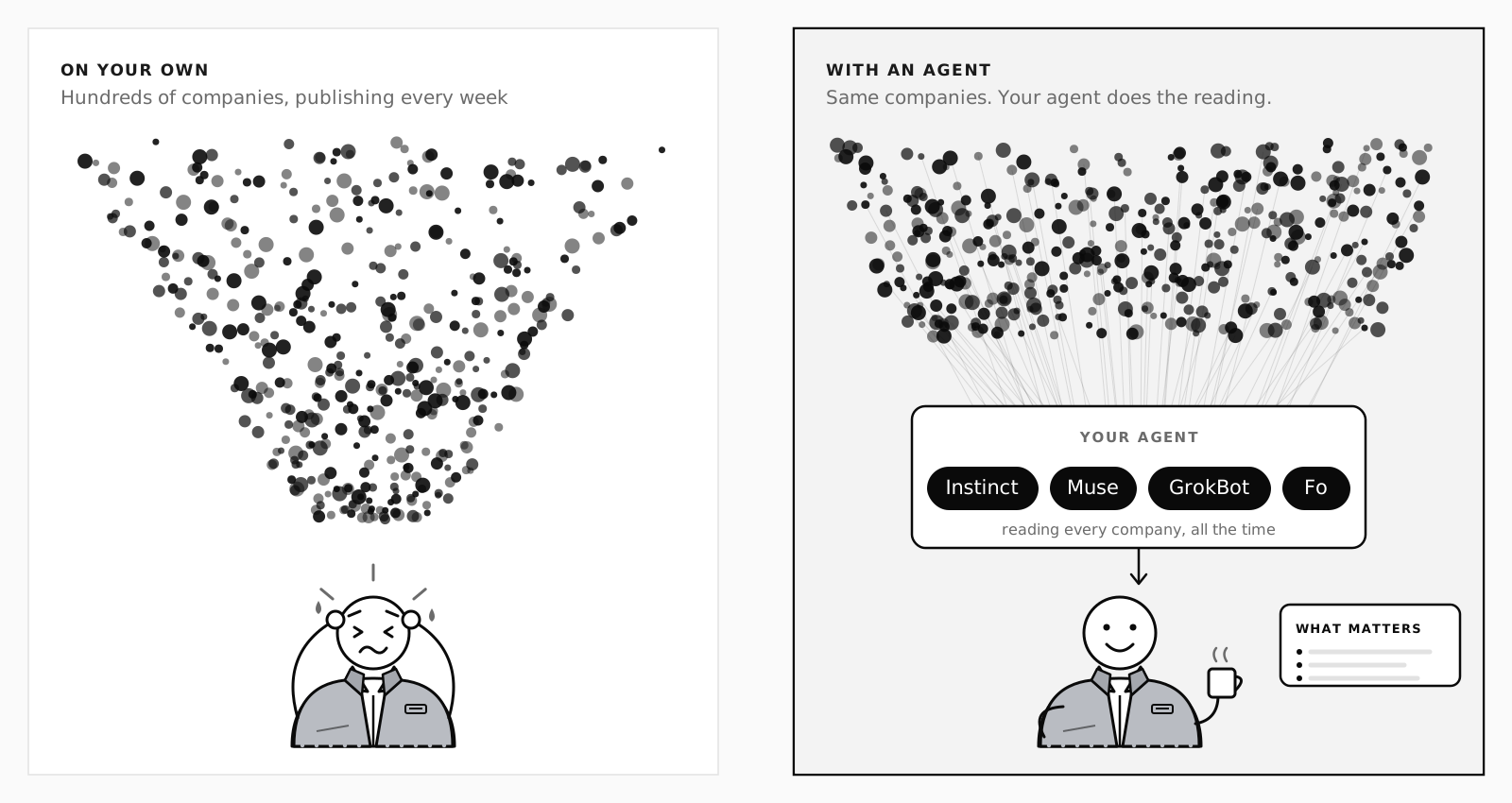
It is impossible for a person to follow
We mean that literally. If you work in AI, whether you invest in it, build with it, sell to it or write about it, you already know the feeling. You open your feeds in the morning and you are behind. By the afternoon you are further behind. Reading faster does not help, because the pace of what is being published is not set by how fast you read.
The usual answer is to follow fewer things. Pick a handful of companies, a few newsletters, a couple of people on social media. That works until the thing that matters comes from a company that was not on your list.
In AI, that happens constantly.
Agents do not have this problem
An agent has no morning feed to get through and no attention to run out. It can read every company on a list of a thousand, every day, and it does not get tired of it. We made this argument in Machines Read Everything: the limit on how much a machine can follow is coverage, not attention.
That changes what the right question is. It is no longer “what can I keep up with?” It is “what should my agent be watching, and can it tell me what matters?”
An agent that can answer that needs something to read. It needs the world it is supposed to watch to be structured, current and source-grounded. That is the part we build.
Where we are today
Synorb now operates the largest library of AI company Streams anywhere, with more than 200 live and public. Each one tracks a single company: what it publishes, what it ships and what it says, delivered as Manifests, which are structured Signals and Briefs with provenance back to the source.
We recently doubled this from just over 100 to more than 200 late-stage AI companies. We are now adding seed-stage companies.
Where we are going
Over the next few weeks we are taking the library from 200 to 1,000 AI company Streams.
That is the focus. Our ambition has not changed: we want machines to be able to follow everything that matters. The way we get there is by building around the primitives that matter, such as companies, people, places, topics and data, and going deepest on the one our users need most right now.
Today, our largest cohort of human users is VCs and AI founders, and the primitive they care about most is the AI company. So for now, we are doubling and tripling down there, until an agent following it can trust that nothing important slipped by.
A thousand is not an arbitrary number. It is roughly the point where the library stops being a list of companies you have heard of and starts being the AI space itself: the labs, the infrastructure companies, the application builders, the tooling, the seed-stage teams who will be the headlines next year.
What this means for your agent
If you are an AI investor, your agent should be paying attention to AI companies. We wrote about this in What Are the Top Connectors for Muse in 2026?: your agent can know everything about your inbox and calendar and still miss what is happening outside them.
With a library this wide, you do not have to choose which companies to follow before you know what matters. You point your agent at the space, and it tells you what changed.
- Start broad, then narrow. Use Beacons to save a tracking goal once, like “pricing changes across foundation model providers,” and have your agent run it on whatever cadence you choose.
- Notice, do not search. As we put it in Good Search Starts Before the Query, search starts with a question. A feed starts with something changing.
- Let your agent find it. Agents can connect on their own and ask Synorb what Streams exist before pulling anything.
Why we are doing it this way
The AI space is the clearest example of a problem we think every field will have. The volume of what matters is growing faster than any person’s capacity to read it, and the readers who can keep up are not people.
We start where the need is sharpest. AI is where the news is moving fastest, where our users already are, and where the gap between what a person can follow and what is worth following is widest. Get it right here, and the same approach carries to every other primitive that matters.
- Browse the library on the coverage page.
- Connect an agent and ask it what AI companies published this week at synorb.com/agents.
- New to Synorb? See how Streams and Manifests work on the product page.